How does B2B Performance Marketing work?
Designing for a rep-free experience means asking... if a highly qualified buyer arrived on our website right now, with budget, with a problem to solve: would they buy? B2B marketing explained.

Welcome to Creative Marketing Performance, your bi-monthly dose of creative inspiration meets data-driven performance marketing insights.
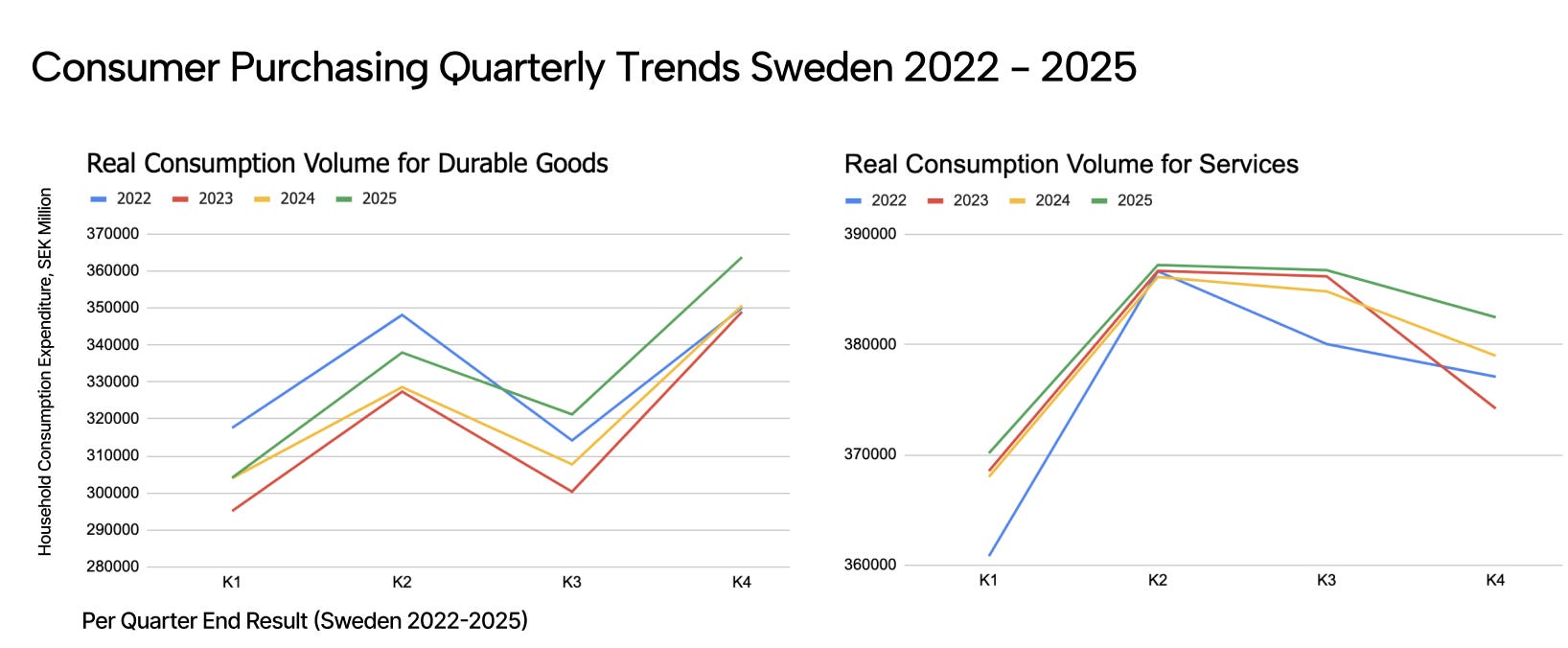
Join us for a free webinar where we data-crunched SCB’s numbers on consumer behaviour and business activity by month to show you the most active and least active months for B2B advertising in Sweden.

Free to attend. Online. Replay available.
👉 Reserve your spot: https://luma.com/xbvgn462
Moody Monday:
Most of B2B marketing is invisible to the people who fund it. You run campaigns, generate leads and then someone in the quarterly review asks “but what did it actually do for revenue?” and the room goes quiet.
If that moment is familiar, this guide is your answer. Now let’s walk through how B2B performance marketing actually works from understanding who you’re selling to, through every stage of the pipeline:
what happens when a buyer decides to buy without ever speaking to a salesperson?

B2B Performance Marketing?
B2B performance marketing is the discipline of running marketing activity that can be directly tied to a measurable business outcome. Not impressions. Not brand lift surveys. Outcomes: pipeline created, deals influenced, revenue closed.
The “performance” framing is important because it separates this from brand marketing (which is valuable but operates on longer timescales and softer metrics) and from traditional lead generation (which often optimises for volume of contacts rather than quality of intent).
Performance marketing in a B2B context means you are tracking what happens after the click, after the form fill, after the content download all the way to whether it contributed to a closed deal.
This matters more than ever right now because the scrutiny on marketing budgets has intensified. Every channel needs to justify its existence. Every campaign needs to connect back to revenue impact. Understanding performance marketing is not just a technical skill, it is the language you need to speak to stay credible in a commercial organisation.
So how do you do it?
It Starts with the ICP
Before you spend a single penny on marketing, you need to know precisely who you are marketing to. In B2B, this is defined by your Ideal Customer Profile, almost universally referred to as an ICP.
Your ICP is not a persona. A persona is a fictional individual with a name and a stock photo. An ICP is a description of the company most likely to buy from you, stay with you, and grow with you over time. It is built from data about your best existing customers the ones who converted quickly, required minimal hand-holding, expanded their contract, and refer others.
A well-defined ICP typically includes
firmographic data (company size by headcount and revenue, industry vertical, geography)
technographic data (what tools and platforms they already use)
and behavioural signals (how they buy, who’s involved in the decision, what triggers a purchase).
It should also include negative signals the types of companies that look like a fit on paper but consistently churn, underperform, or drain disproportionate resources.
Once you have it, your ICP becomes the filter for every marketing decision you make. Channel selection, message framing, content topics, ad targeting, outbound lists, event attendance — all of it runs through the question: does this put us in front of our ICP?
The ICP’s Buyers’ Committee.
Who You’re Actually Selling To.

In B2B, there is almost never a single buyer. There is a committee.
Research consistently shows that the average B2B purchase decision at a mid-to-large company involves between six and ten stakeholders. Each of them has different concerns, different information needs, and different levels of authority. Your marketing has to work for all of them… not just the person who filled in your form.
A typical buyers’ committee for a software purchase might include a champion (the internal advocate who found you and wants to push the project forward), an economic buyer (usually a VP or C-level who controls the budget and ultimately signs off), technical evaluators (who want to know about security, integrations, and implementation complexity) and a procurement contact (who will negotiate on price and terms regardless of how enthusiastic everyone else is).
The implication for marketing is significant. Content and campaigns need to be designed for multiple audiences simultaneously. A case study needs a version that speaks to the economic buyer (ROI, time to value, risk reduction) and a version that speaks to CMO (ease of use, specific workflow improvements). A product demo page needs to address technical questions without losing the executive who just wants to know if it works.
Great B2B marketing doesn’t just generate a lead. It arms the champion with the evidence they need to convince the rest of the committee… even in meetings where your sales team isn’t in the room.
The Rep-Free Experience
This is where B2B has fundamentally changed in the last five years. The majority of the B2B buying journey now happens before a buyer speaks to anyone in sales. Gartner research has suggested that buyers spend as little as 17% of their total buying time in conversations with vendors and when they are talking to multiple vendors simultaneously, that number drops further still.
What are they doing with the other 83% of their time? They are researching independently. Reading comparison sites. Watching product demos on YouTube. Going through peer review platforms like G2 or Capterra. Asking colleagues who’ve bought similar tools. Consuming your content, if it exists and if it’s genuinely useful.
This means your marketing has to do a substantial portion of the selling. The website, the content library, the pricing page, the case studies, the product tour: For a large portion of your pipeline, they are the sales conversation.
Designing for a rep-free experience means asking: if a highly qualified buyer arrived on our website right now, with budget, with a problem to solve, and with zero interest in talking to a salesperson until they were ready… could they get everything they needed to make a decision? Could they see pricing or at least a pricing framework? Could they watch a product demo? Could they read a case study from a company that looks exactly like them? Could they self-qualify?
If the answer to any of those is no, you have pipeline leaking out of your funnel before it ever registers as a lead.
Building Pipeline
Buying journeys are rarely linear. But as a planning framework for marketing activity, thinking in early, middle, and late pipeline stages remains useful. Here’s what each stage looks like in practice and what marketing’s job is at each one.
Early Pipeline: Creating Awareness and Demand
At the top of the funnel, you are talking to people who either don’t know you exist, or know you exist but haven’t connected you to a problem they’re trying to solve. Your job here is to create the conditions that make leads possible.
Early funnel marketing typically includes content marketing (thought leadership articles, research reports, original data, educational video), paid social for awareness (campaigns designed to reach your ICP with relevant, valuable content rather than a sales message), SEO-driven content targeting problem-aware search queries, podcast sponsorships or appearances where your ICP is already listening, and community engagement in spaces your buyers frequent.

Middle Pipeline: Nurturing Consideration and Building Preference
By the middle of the funnel, you are dealing with buyers who have a problem, are actively evaluating options, and have shown some level of interest in you. They’ve read your content, visited your site, engaged with an ad, or been identified by an outbound motion as a target account. Your job now is to build preference before the sales conversation becomes formal.
Middle funnel marketing includes comparison content (how you stack up against alternatives — write this yourself before a competitor does), detailed case studies organised by industry and use case, product tour videos and demo environments that buyers can explore at their own pace, retargeting campaigns that stay present as buyers continue their research across the web, and email nurture sequences triggered by content engagement rather than time-based drips.
Late Pipeline: Accelerating Decisions and Reducing Risk
Late pipeline is where marketing and sales are operating most closely together. You have a qualified opportunity in the CRM. The committee has been identified. There is active evaluation happening, which may include a proof of concept, a procurement process, or a competitive shortlist.
Marketing’s job at this stage is to reduce friction and reduce perceived risk. That means having the right content ready to address last-minute objections: security documentation, integration guides, implementation timelines, reference customers from the exact same industry the prospect is in. It means running targeted campaigns to the buying committee at accounts that are in late-stage pipeline. Not to generate new interest, but to reinforce credibility and stay present during the decision window. And it means having a clear handoff with sales on what content is being used at which stage of a deal, so nothing contradicts and everything reinforces.
Take Aways
The teams that do B2B performance marketing well share a few habits. They define their ICP rigorously and review it regularly. They build marketing that works for the full buying committee, not just the person who converts first. They design their website and content library to serve buyers who will never speak to a salesperson until they’re already sold. They plan their marketing activity across the full pipeline, not just the top and they measure outcomes at each stage, not just volume.
The goal is never to generate noise. It is to be exactly the right thing, in exactly the right place, for exactly the right person at the moment they need it most. That is what performance means. And when you get it right, the quarterly review gets a lot less quiet.

Work With Me:
Curious what it would be like to work together? Get 3 free digital ads on-brand. Book me for a meeting.
Pricing:
Design Support – Scroll-stopping creatives that Perform in Campaigns (starting at 20K-55k sek a month: depending on volume)
Website Development – Sites built for both style, security and business goals. Built with react. (starting at 70-85K lump sum full website design + hosting)
Branding – Strategic identity work that resonates, stands out and drives results (60-85K lump sum includes brand book & digital asset library)
🚀 Alexandra
Alexandra Grisanti, Growth Designer
Explore more atAlexandra Studio
Creative Performance Marketing | Design | Strategy